
Abnormal vaginal bleeding is common, especially around the menopause, but sometimes it can be caused by a condition called endometrial hyperplasia.
Endometrial hyperplasia means that the lining of the womb, known as the endometrium, has become thicker than normal because the cells in the lining have grown too much.
Most cases are not cancer. However, some types of endometrial hyperplasia can increase the risk of developing cancer of the womb lining, which is why appropriate investigation, treatment and follow-up are important.
This article is based on guidance from the Royal College of Obstetricians and Gynaecologists (RCOG), Green-top Guideline No. 67.
What is endometrial hyperplasia?
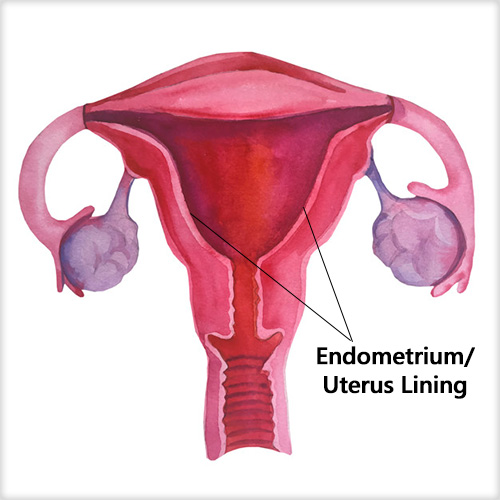
The inside of the womb is covered by a layer of tissue called the endometrium.
During the menstrual cycle, hormones cause this lining to grow and then shed during a period.
Endometrial hyperplasia develops when the womb lining continues to grow without being adequately balanced by the hormone progesterone.
This is usually caused by prolonged exposure to the hormone oestrogen without enough progesterone.
There are two main types.
| Type | What it means |
|---|---|
| Endometrial hyperplasia without atypia | The womb lining is overgrown, but the cells still look relatively normal. The risk of developing cancer is low. |
| Atypical endometrial hyperplasia | Some cells look abnormal. This carries a much higher risk of womb cancer and needs closer treatment and follow-up. |
What symptoms can it cause?
The most common symptom is abnormal uterine bleeding.
This may include:
- very heavy periods
- periods that last longer than usual
- bleeding between periods
- irregular periods
- bleeding after the menopause
- unexpected bleeding while using hormone replacement therapy.
Some people may have no symptoms and the condition may be discovered during investigations for another reason.
What causes endometrial hyperplasia?
The main cause is prolonged exposure of the womb lining to oestrogen without enough progesterone.
Situations that can increase the risk include:
- being overweight or living with obesity
- having irregular or absent ovulation
- polycystic ovary syndrome
- approaching the menopause, when ovulation may become less regular
- taking oestrogen-only hormone replacement therapy when the womb is still present
- taking tamoxifen
- certain rare ovarian tumours that produce oestrogen.
Obesity is particularly important because body fat can convert other hormones into oestrogen, increasing exposure of the womb lining.
How is it diagnosed?
An ultrasound scan can sometimes show that the womb lining is thicker than expected, but ultrasound alone cannot confirm endometrial hyperplasia.
The diagnosis is usually made by taking a small sample of the womb lining. This is called an endometrial biopsy.
The sample is examined under a microscope by a specialist pathologist.
Sometimes a hysteroscopy is recommended. This involves passing a thin camera through the cervix to look inside the womb.
Hysteroscopy may be particularly useful if:
- an endometrial biopsy cannot be obtained
- the first biopsy does not provide enough tissue
- a polyp or another localised abnormality is suspected.
Hyperplasia without atypia
Most women with endometrial hyperplasia without atypia will not develop cancer.
RCOG guidance estimates that the risk of this type progressing to womb cancer is less than 5% over 20 years.
In many cases, the abnormal lining can return to normal.
Can it improve without treatment?
Yes.
Studies quoted in the RCOG guideline suggest that around 74% to 81% of cases may improve without hormonal treatment, particularly if the underlying cause is corrected.
However, treatment is usually advised when there is ongoing abnormal bleeding or when the condition does not improve.
What is the main treatment?
The main treatment is progesterone-based hormone therapy.
The preferred treatment is usually a levonorgestrel-releasing intrauterine system, commonly known as a hormonal coil or LNG-IUS.
This is placed inside the womb and releases progesterone directly onto the womb lining.
It is usually preferred because it:
- is highly effective
- causes fewer whole-body side effects than tablets
- often improves heavy bleeding
- has a higher chance of reversing the hyperplasia.
If a hormonal coil is not suitable or is declined, progesterone tablets may be offered.
These may include:
- medroxyprogesterone
- norethisterone.
Continuous progesterone treatment is generally more effective than taking progesterone for only part of each month.
How successful is treatment?
Treatment is usually very effective.
| Outcome | Approximate figures quoted by RCOG |
|---|---|
| Improvement without hormone treatment | 74–81% |
| Improvement with progesterone treatment | 89–96% |
| Risk of cancer with hyperplasia without atypia | Less than 5% over 20 years |
Treatment usually needs to continue for at least 6 months.
If a hormonal coil works well and is tolerated, it may be left in place for up to 5 years to help reduce the chance of the condition returning and to help control bleeding.
Will I need repeat biopsies?
Yes.
Follow-up is important because doctors need to make sure that the womb lining has returned to normal.
For hyperplasia without atypia, RCOG recommends repeat endometrial biopsies, usually at intervals of around 6 months.
In general, doctors would like to see two normal biopsies in a row, taken at least 6 months apart, before considering discharge from follow-up.
Some people may need longer follow-up, particularly those with a higher risk of recurrence.
For example, women with a BMI of 35 or above may have a greater chance of the condition returning.
When might a hysterectomy be recommended?
A hysterectomy means surgical removal of the womb.
It is not usually the first treatment for endometrial hyperplasia without atypia.
However, it may be recommended if:
- the condition develops into atypical hyperplasia
- the abnormal lining has not returned to normal after about 12 months of treatment
- the condition comes back after treatment
- troublesome bleeding continues
- regular biopsies or hormone treatment are not acceptable or practical.
A hysterectomy is a definitive treatment because once the womb is removed, endometrial hyperplasia cannot return.
What is atypical endometrial hyperplasia?
Atypical hyperplasia is more serious because the cells in the womb lining look abnormal under the microscope.
There is a significant risk that these abnormal cells may develop into cancer.
There is also a possibility that an early cancer may already be present but was not detected in the initial biopsy.
RCOG reports that up to 43% of women diagnosed with atypical hyperplasia may be found to have an existing endometrial cancer when the womb is examined after hysterectomy.
The estimated risk of developing cancer also increases over time.
| Time after diagnosis | Approximate risk of developing womb cancer |
|---|---|
| 4 years | 8% |
| 9 years | 12% |
| 19 years | 28% |
Because of this higher risk, atypical hyperplasia needs careful management.
How is atypical hyperplasia treated?
For women who have completed their family and are medically fit for surgery, the usual recommended treatment is a total hysterectomy.
In women who have been through the menopause, removal of the ovaries and fallopian tubes is usually also recommended.
For younger women, whether the ovaries should be removed depends on individual circumstances and should be discussed carefully.
Can fertility be preserved?
Sometimes.
A woman who wishes to have children may choose to delay hysterectomy, but this requires specialist care because atypical hyperplasia has a significant cancer risk.
Before fertility-preserving treatment is started, doctors will usually try to exclude an existing cancer and discuss the case within a specialist team.
A hormonal coil is generally the preferred treatment.
Close follow-up is essential, usually including an endometrial biopsy every 3 months initially.
Research quoted by RCOG suggests that approximately 86% of women may initially respond to fertility-preserving treatment. However, around 26% may later experience a recurrence.
Once childbearing is complete, hysterectomy is usually recommended because of the ongoing risk of the abnormal cells returning or progressing.
Does endometrial hyperplasia always mean cancer?
No.
Most women with endometrial hyperplasia without atypia will not develop womb cancer.
However, atypical hyperplasia is different and carries a much greater cancer risk.
The important message is that endometrial hyperplasia is treatable, and careful follow-up allows changes in the womb lining to be detected and managed early.
When should you seek medical advice?
Speak to your GP or gynaecology team if you experience:
- bleeding after the menopause
- very heavy periods
- periods that have suddenly become much more irregular
- bleeding between periods
- persistent unexpected bleeding while using HRT
- bleeding that is unusual for you.
Bleeding after the menopause should always be assessed.
Key points
Endometrial hyperplasia is an overgrowth of the lining of the womb and is a recognised cause of abnormal uterine bleeding.
Hyperplasia without atypia usually has a low risk of becoming cancer and can often be successfully treated with progesterone, particularly a hormonal coil.
Atypical hyperplasia carries a much higher risk of womb cancer and usually requires hysterectomy unless there is a strong reason to preserve fertility.
Regular follow-up and repeat biopsies are an important part of treatment.
Source
Royal College of Obstetricians and Gynaecologists and British Society for Gynaecological Endoscopy.
Management of Endometrial Hyperplasia — Green-top Guideline No. 67.
This article is intended for general health information and does not replace individual medical advice. Anyone experiencing abnormal vaginal bleeding, particularly bleeding after the menopause, should seek medical assessment.
Read also: Batholin’s Cyst and abscess: Causes, Symptoms and Treatment